Incense guide · 2026-07-26
Incense Sticks vs. Backflow Incense: What’s the Difference?
Incense sticks send smoke upward and are simple to use with a holder. Backflow incense uses a special cone and compatible burner to guide smoke downward for a visual effect.
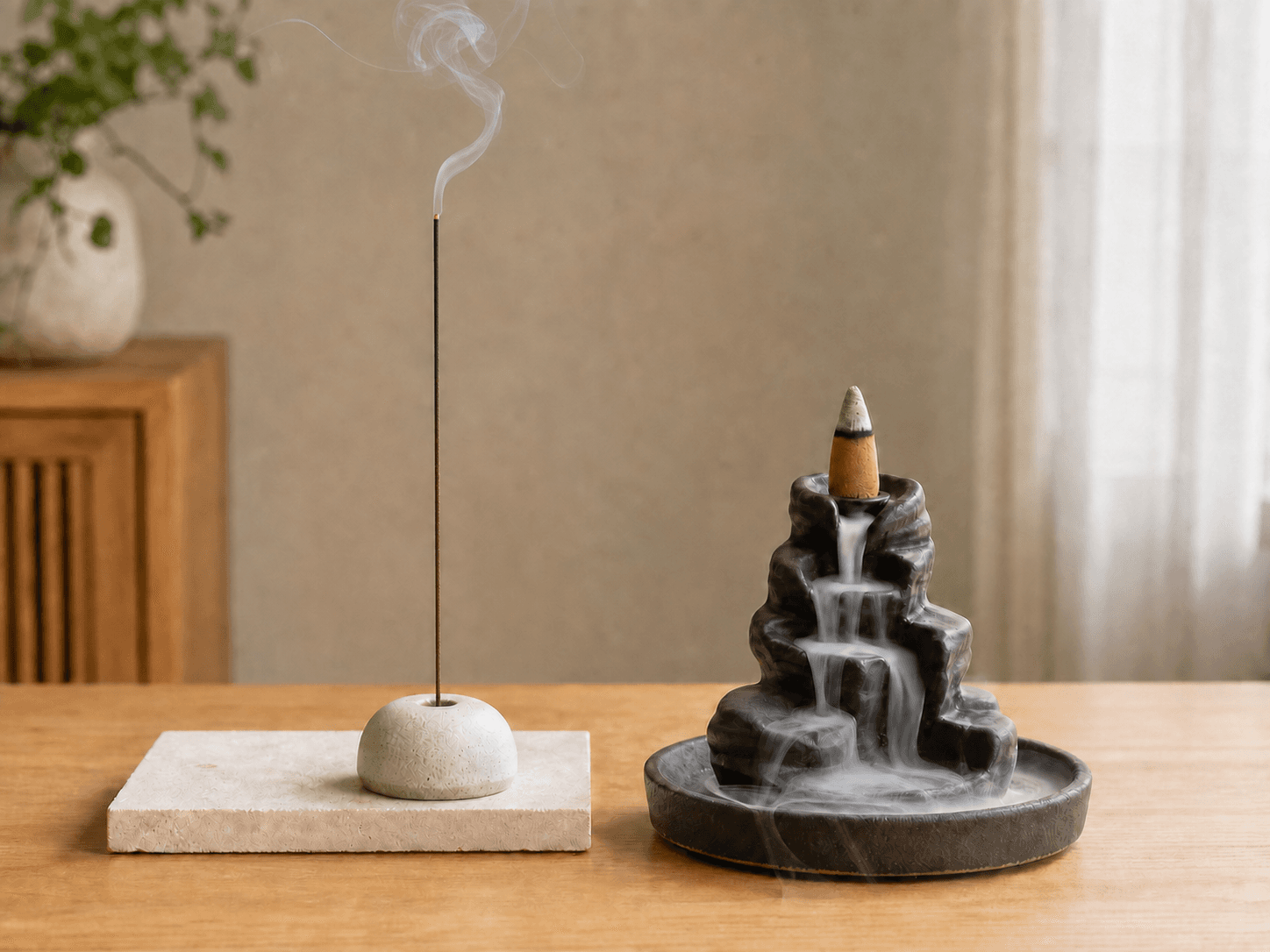
Incense sticks and backflow incense are different formats made for different priorities. Incense sticks are long and narrow, burn from one end, and send smoke upward. Backflow incense is usually cone-shaped and works with a compatible burner that guides smoke downward.
If your priority is a straightforward scent ritual with minimal setup, choose incense sticks. If your priority is a visible smoke-waterfall effect, choose backflow incense and its matching burner.
Quick comparison
| Feature | Incense sticks | Backflow incense |
|---|---|---|
| Form | Long, narrow stick | Usually a hollow cone |
| Smoke direction | Rises naturally | Exits below and follows the burner downward |
| Equipment | Heat-resistant incense holder | Compatible backflow burner |
| Main priority | Scent and straightforward daily use | Visual smoke display |
| Airflow | Ventilation is necessary | Ventilation is necessary, but strong drafts can break the visual effect |
| Cleanup | Ash around the holder | Ash plus possible residue in burner channels |
What are incense sticks?
Incense sticks are long, narrow pieces of incense that burn slowly from one end. They fit into a suitable incense holder and do not need a special smoke-channel burner.
To use one, place it securely in a heat-resistant holder, light the tip, extinguish the flame, and let the glowing ember burn under supervision.
What is backflow incense?
Backflow incense is commonly made as a cone with an internal passage. The cone’s lower opening aligns with an opening in a compatible burner. Smoke collects below the cone and is guided through channels in the burner, creating the familiar downward-flowing effect.
The effect depends on the cone, burner, and surrounding air. A regular cone on an ordinary dish will not create the same result, and a strong fan, open window, or air-conditioning draft can interrupt the smoke path.
Do they smell the same?
Not necessarily. Shape alone does not tell you the ingredients, fragrance strength, or quality of either product. Incense sticks and backflow cones can both vary widely by formula.
Choose by the experience you want:
- Choose incense sticks when scent, simple equipment, and an easy daily routine matter most.
- Choose backflow incense when the moving smoke display is the main attraction and you are willing to use a dedicated burner.
Neither format proves that an incense is “natural.” Check the ingredient information provided by the seller and pay attention to how the product behaves when burned in a ventilated room.
Which is easier for everyday use?
For most daily scent routines, incense sticks are the simpler option. They take up little space, need only a suitable holder, and are easy to position on a stable surface away from fabrics and drafts.
Backflow incense needs a compatible burner with aligned openings. Burner channels may also need cleaning if residue collects, so follow the burner maker’s instructions.
Safety and ventilation
Both formats are burning products. Use them with the same basic precautions:
- Put the incense on a stable, heat-resistant surface.
- Keep it away from curtains, paper, bedding, shelves, and other combustible materials.
- Never leave burning incense unattended.
- Keep children and pets away from the burner and ash.
- Ventilate the room. The U.S. Environmental Protection Agency specifically recommends proper ventilation when burning incense indoors.
- Stop use if the smoke causes discomfort, and do not treat incense as a medical product.
The best choice depends on whether you want a scent-led, simple routine or a visual smoke display—and whether you can use the chosen format safely.
What is the difference between incense sticks and backflow incense?
Incense sticks are long and narrow, burn from one end, and send smoke upward. Backflow incense usually uses a hollow cone and a compatible burner to guide smoke downward for a visual effect. Incense sticks are simpler for everyday scent use, while backflow incense requires dedicated equipment.
FAQ
What is the main difference between incense sticks and backflow incense?
Incense sticks burn from one end and send smoke upward. Backflow incense usually uses a hollow cone and a compatible burner to guide smoke downward for a visual display.
Does backflow incense need a special burner?
Yes. The cone’s lower opening must align with a compatible backflow burner so smoke can enter and follow the burner’s channels.
Which format is easier for everyday use?
Incense sticks are usually simpler because they need only a suitable heat-resistant holder. Backflow incense requires a matching burner and more cleanup.
Sources
Related reading
What Incense Sticks Are Suitable for a Yoga Space?
Yoga spaces are better suited to soft, low-smoke, stable-burning incense sticks with gentle woody, herbal, or light floral scent directions.
Read article →What Are the Main Ingredients of Incense Sticks?
Incense sticks are typically made from fragrance powders, base powders, and binders. Some recipes also include resins, herbs, flowers, or spices.
Read article →What Are the Common Forms of Incense?
Common incense forms include incense sticks, coils, cones, incense powder, incense seal, incense pellets, incense cakes, and sachets. Each form is suited to different spaces, burn times, smoke levels, and usage methods.
Read article →