Incense guide · 2026-07-27
What Are the Main Ingredients of Incense Sticks?
Incense sticks are typically made from fragrance powders, base powders, and binders. Some recipes also include resins, herbs, flowers, or spices.
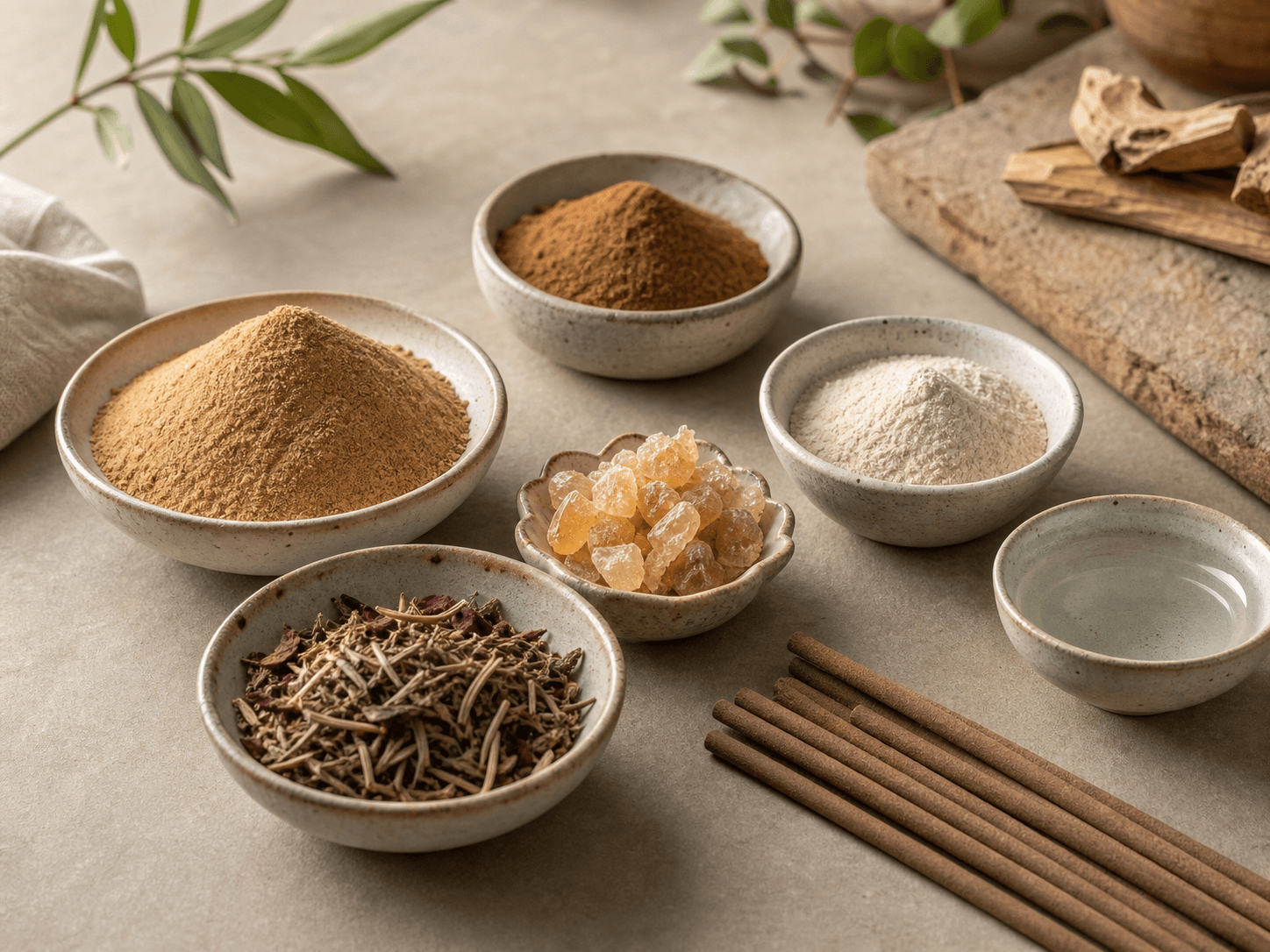
Incense sticks are typically made from fragrance powders, base powders, and binders. Some recipes also include resins, herbs, flowers, or a small amount of spices. These ingredients affect the incense's scent, smoke volume, burn evenness, and the stick's shape retention.
Simply put, incense is not just scent attached to a stick. A good incense stick needs a clear scent, stable burning, and enough structural integrity to withstand handling and shipping. The combination of ingredients is key to achieving this.
What materials are mainly used in incense sticks?
Most incense sticks contain aromatic materials, base powders, and binders.
Aromatic materials give incense sticks their primary scent. Base powders help shape the stick and affect how it burns. Binders hold the powder materials together, allowing the incense stick to be rolled, dried, handled, and burned as a stick.
This is especially important for bamboo-free incense. Bamboo-free incense has no bamboo core inside, so the incense body itself must provide both scent and structure.
What role does wood powder play in incense sticks?
Wood powder often forms the base of an incense stick's scent.
Common woody materials include sandalwood, cedar, cypress, and agarwood. These materials can smell warm, dry, clean, soft, or slightly resinous. Sandalwood typically feels smooth and mellow. Cedar is drier and cleaner. Agarwood can be deeper and heavier, depending on grade and recipe.
In well-made incense sticks, wood powder is not always a filler; it can be part of the actual scent.
Why are resins used in incense sticks?
Resins add depth, brightness, sweetness, or a more ceremonial feel to incense sticks.
Common resin materials include frankincense, myrrh, and benzoin. Frankincense typically smells bright and resinous. Myrrh is usually warmer and deeper. Benzoin can add a soft sweetness.
Resins must be balanced in the recipe. Too much resin can make the incense stick harder to shape, harder to dry, or less stable when burning.
What role do herbs and flowers play?
Herbs and flowers are often used to adjust the scent direction.
Lavender can make an incense blend feel softer. Sage can make it smell drier and more herbal. Clove and cinnamon can add spicy notes. Materials like patchouli or mugwort can make the scent feel more earthy or vegetative.
These materials should be described as aromatic materials, not as medicines. Incense may create a quiet atmosphere, but should not be described as treating sleep, stress, illness, or any medical condition.
Why do incense sticks need binders?
Binders help the powdered incense materials stick together into a stick shape.
Without binders, fragrance powders and base powders cannot form a stable incense stick. In bamboo-free incense, binders are especially important because there is no bamboo stick core for support. Common natural binders include makko powder and other plant-based binding powders.
The right binder helps the incense stick dry evenly, remain intact, and burn more smoothly. Incorrect binder ratios can make the incense stick brittle, fragile, or prone to going out.
Do base powders affect how incense sticks burn?
Base powders affect burn rate, smoke volume, and burning stability.
Some incense recipes use wood powder, charcoal powder, or other plant powders as a base. A good base should support stable burning without overpowering the scent of the aromatic materials.
If the base material is coarse or the ratio is off, the incense stick may smell smoky, dusty, harsh, or burnt.
How can you tell if the ingredients are clear?
Most people don't need to know every detail of an incense recipe. A few simple checks are enough.
Pay attention to the scent before burning, the scent while burning, smoke volume, burn behavior, and product description. If the incense stick smells too strong, too sweet, or too perfumey before burning, or smells burnt and murky when burning, the recipe may not be suitable for your space.
Clear ingredient descriptions help people understand the suitable scenarios for incense: small rooms, larger spaces, morning routines, evening rituals, or quiet background scent.
A good incense stick does not need to be strongly scented. It should smell clean, burn steadily, and have a reasonable recipe. In a room, it should feel like a background scent, not heavy smoke.
What are the main ingredients of incense sticks?
Incense sticks are typically made from fragrance powders, base powders, and binders. Some recipes also include resins, herbs, flowers, or spices. These ingredients affect scent, smoke volume, burn rate, burning stability, and stick strength.
FAQ
What are incense sticks usually made of?
Most incense sticks use fragrance powders, base powders, and binders. Some recipes also include resins, herbs, flowers, or spices.
Why do incense sticks need binders?
Binders hold the powder materials together, allowing the incense stick to be shaped, dried, handled, and burned as a stable stick.
Do incense stick ingredients affect burning?
Yes. Base powders, binders, resins, particle size, and recipe balance affect burn rate, smoke production, and burning stability.
Sources
Related reading
What Incense Sticks Are Suitable for a Yoga Space?
Yoga spaces are better suited to soft, low-smoke, stable-burning incense sticks with gentle woody, herbal, or light floral scent directions.
Read article →What Are the Common Forms of Incense?
Common incense forms include incense sticks, coils, cones, incense powder, incense seal, incense pellets, incense cakes, and sachets. Each form is suited to different spaces, burn times, smoke levels, and usage methods.
Read article →What Is Blended Incense?
Blended incense is made by mixing two or more aromatic materials in specific proportions to create a fuller fragrance. It can be made into incense sticks, spiral incense, cones, incense powder, pellets, cakes, or sachets.
Read article →