Incense guide · 2026-07-27
What Are the Common Forms of Incense?
Common incense forms include incense sticks, coils, cones, incense powder, incense seal, incense pellets, incense cakes, and sachets. Each form is suited to different spaces, burn times, smoke levels, and usage methods.
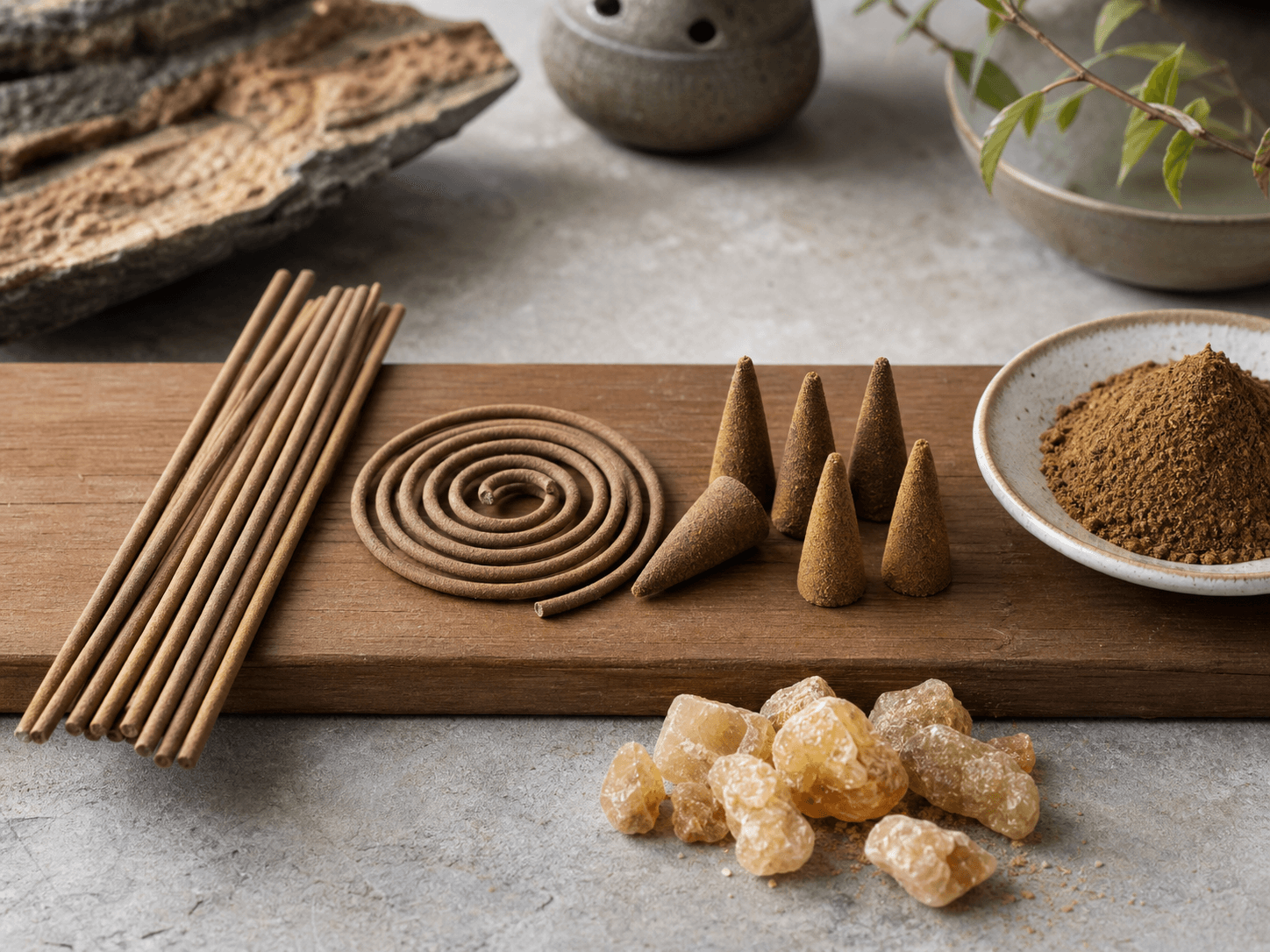
Common incense forms include incense sticks, coils, cones, waterfall incense, incense powder, incense seal, incense pellets, incense cakes, and sachets. The form affects usage method, burn time, smoke level, and the type of incense holder or burner required.
For daily use, incense sticks are usually the easiest starting point. If you need a longer burn time, coils may be more suitable. For visual smoke effects, cones or waterfall incense are common. For traditional heating methods, incense powder, seal, pellets, or cakes may be more appropriate. Sachets are different because they do not need to be lit.
Overview of Common Incense Forms
Incense sticks are thin sticks, suitable for simple daily use. Incense coils are spiral-shaped, often used for longer burn times. Incense cones are small cones that release fragrance faster. Waterfall incense is a type of cone with a chimney that creates a downward smoke effect.
Incense powder is powdered incense material used for heating, incense seal, or making incense. Incense seal involves arranging powder into patterns, often used in quiet indoor settings. Incense pellets and cakes are compressed incense materials used for heating. Sachets contain aromatic materials in small pouches and can be used without flame or smoke.
How do incense forms differ in daily use?
The main differences are in burn time, smoke level, and preparation.
Incense sticks are simple to use. You need a holder, a safe surface, and ventilation. Coils burn longer but need more space for ash. Cones release fragrance faster, so they may feel smokier in smaller rooms.
Incense powder, seal, pellets, and cakes rely more on tools. You may need a burner, ash, molds, charcoal, or an electric heater. Sachets are the simplest flameless option because they produce no smoke or ash.
Which incense form should beginners choose?
Most beginners should start with incense sticks.
Incense sticks are easier to control because they have a moderate burn time, a simple holder, and if the fragrance is enough, users can burn only part of the stick. This makes sticks more forgiving than forms with longer burn times or heavier smoke.
For everyday use, incense sticks are easy to understand, store, and handle. For someone choosing an incense form for the first time, sticks are a practical starting point before exploring coils, cones, powder, or resin.
There is no single best incense form. The key question is which form suits your space, burn time, smoke level, and usage method.
What are the common forms of incense?
Common incense forms include incense sticks, coils, cones, waterfall incense, incense powder, incense seal, incense pellets, incense cakes, and sachets. Each form changes burn time, smoke level, preparation method, and the type of incense holder or burner needed.
FAQ
What are the most common forms of incense?
Common forms include incense sticks, coils, cones, waterfall incense, incense powder, incense seal, incense pellets, incense cakes, and sachets.
Which incense form is best for beginners?
Incense sticks are usually the easiest to start with because they are easy to hold, package, light, and control.
Which incense form does not produce smoke?
Sachets do not need to be lit, so they produce no smoke or ash.
Sources
Related reading
What Incense Sticks Are Suitable for a Yoga Space?
Yoga spaces are better suited to soft, low-smoke, stable-burning incense sticks with gentle woody, herbal, or light floral scent directions.
Read article →What Are the Main Ingredients of Incense Sticks?
Incense sticks are typically made from fragrance powders, base powders, and binders. Some recipes also include resins, herbs, flowers, or spices.
Read article →What Is Blended Incense?
Blended incense is made by mixing two or more aromatic materials in specific proportions to create a fuller fragrance. It can be made into incense sticks, spiral incense, cones, incense powder, pellets, cakes, or sachets.
Read article →